Gillian Ayres: Feasting on beauty
8 July 2026
Gillian Ayres (1930-2018) once said: ‘To me, art – colour in art – is wonderfully indulging. I don’t see why you shouldn’t be filling yourself up, making yourself happy. Enjoying yourself. Feasting on beauty. I want an art that’s going to make me feel heady, in a high-flown way.’ Presented across three galleries, 'A Life in Colour' is a timely exploration of her phenomenal legacy through paintings made over the course of seven decades – highlighting the power of painting as a means of nonverbal expression. Here’s an insight into five of the works in the show.
Hampstead Murals
Hampstead Murals (1957) were painted on board and in situ at South Hampstead High School for Girls in 1957 with the four panels comprising one single masterpiece. Painting with a freedom that allowed for chance and improvisation to find ‘the essence of something’, the surfaces include puddles of pigment, fluid areas worked with turps, Jackson Pollock-style drips and runs, as well as softer and more thinly brushed areas. Ayres once said of the murals that ‘they painted themselves’ and a willingness to allow the paint and turps to do their thing was key to her method. The murals have been described as ‘the only true British contribution to American abstract expressionism’.
Brood
When her peers turned to cooler lines and fashionable geometry in the 1960s, Ayres’ style remained exuberant and sensuous. Works like Brood (1962) and a sister painting Untitled (1962) were painted quickly with large brushes. They explore the freedom with which she approached the act of painting – capturing the outlines of natural forms reminiscent of plankton, eggs or single celled organisms.
Untitled (Cerise)
The early 1970s marked a period when both Ayres and painting were out of fashion. She responded by making paintings so big – on a roll of canvas so long – that they had to be painted in the garden. Untitled (Cerise) from 1972 was painted in acrylic is over five and a half metres long. It has been described as ‘a wall of pink… with starbursts, splashes, cascades and rivulets of other colours; green, red, honey, yellow… a pink cosmos populated by vivid falling stars.’
Helios
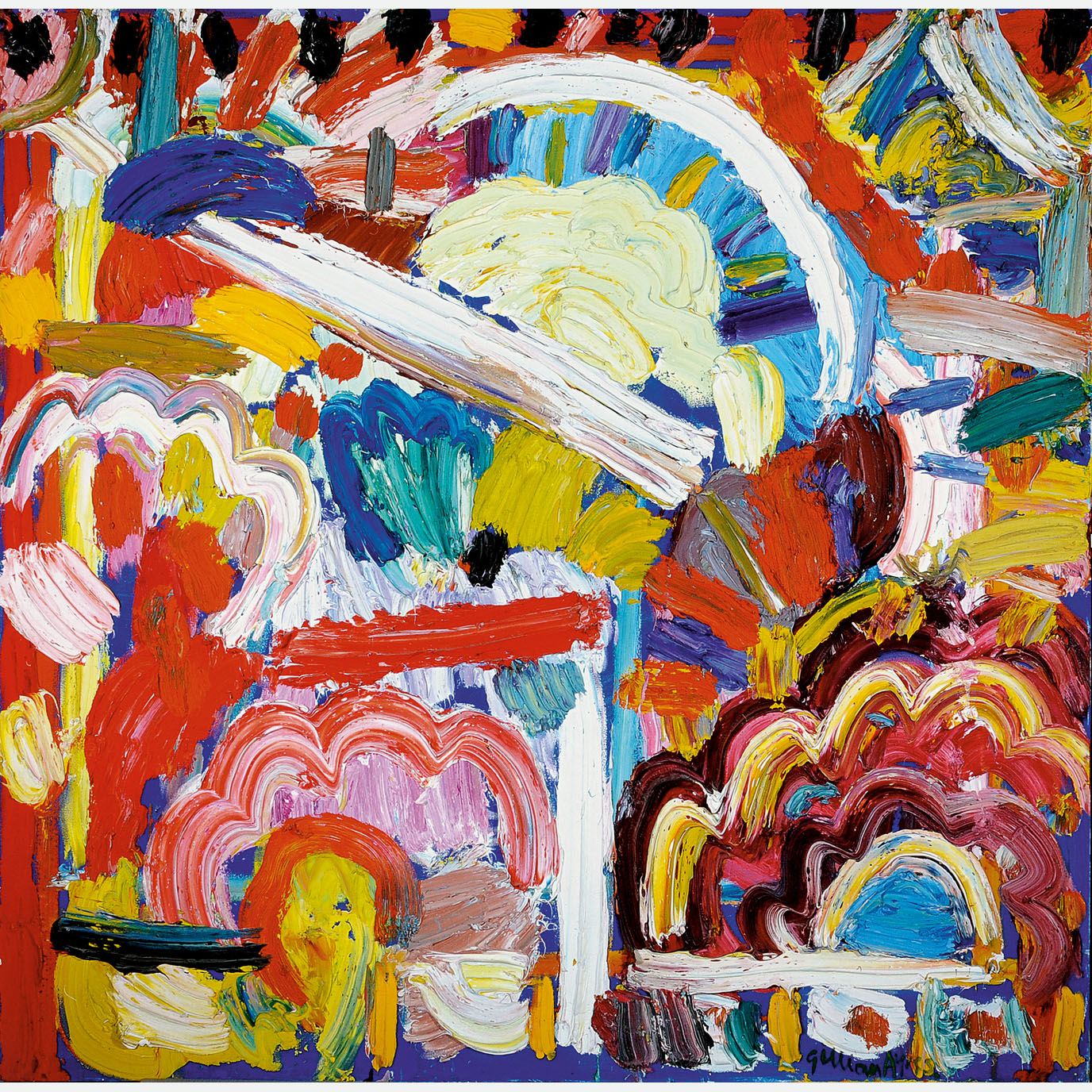
Throughout the 1990s Ayres travelled extensively, including to Jaipur for the Seventh-Triennale India in January 1990, invited by the British Council. The intensity of the heat, light and colour that she experienced found its way into her paintings and Helios (1990) named after the Greek sun god, captures this experience, with the sun depicted as ‘a radiant orb rising at the top of the picture.’
Sundark Blues
Sundark Blues (1994), which Ayres once described as ‘a bloody big painting’ is one of many she made whilst living in North Devon. At four metres wide it contains a whole cosmos of form and colour, sea and sky, a rising sun, as well as the moon and stars. It’s both intimate – the marks and brushstrokes representing the movement of the artist’s hand, wrist, arm – and vast.
'Gillian Ayres: A Life in Colour' is on display at The Box Plymouth until the end of Sunday 4 October. Exhibition opening hours are 10am-5pm Tuesday-Sunday and Bank Holiday Monday. Admission is free and you can book tickets in advance to enjoy priority access.
Thanks to Hannah Hooks, contemporary art curator